Cobblemon Fossils Guide: All 15 Fossils and Revival
By Poke Legends Team · Published · Last updated
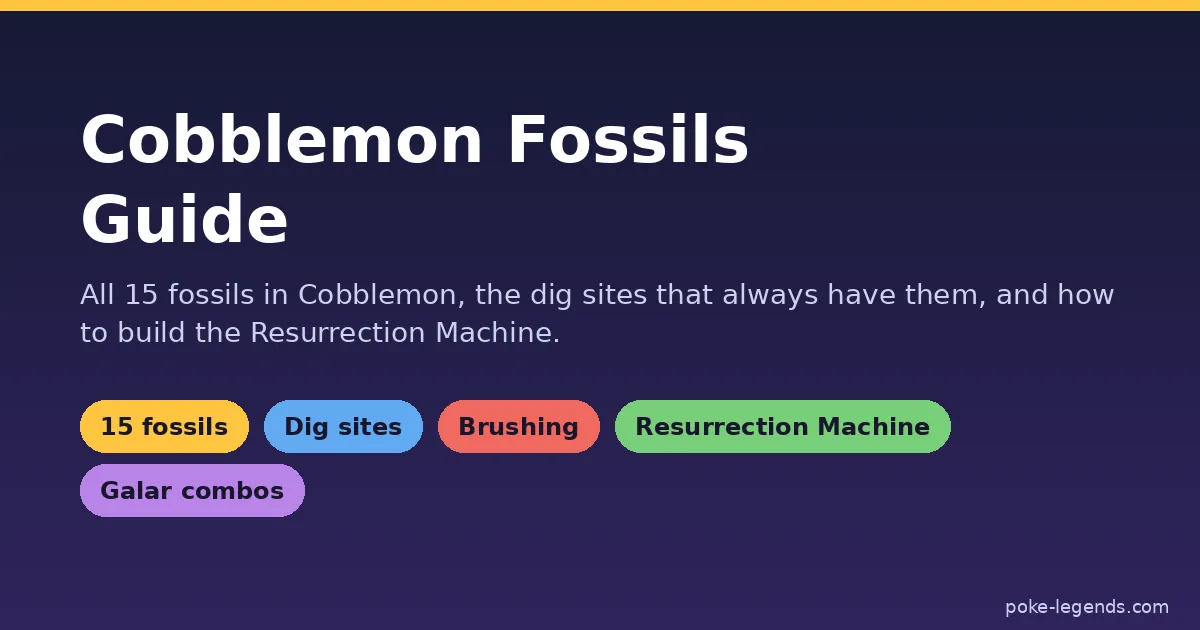
A Cobblemon fossils guide has to cover more than a list of names. In Cobblemon, fossils come from archaeology: you craft a brush, find the small prehistoric dig sites that generate in the right biomes, and excavate suspicious sand or suspicious gravel. One of those blocks (two, if you are at a preserved skeleton) is a rare block that always holds that site’s fossil. The rest of the site can still be worth brushing, because uncommon blocks can drop mixed fossils and other finds. Once you have the piece you want, you build a Resurrection Machine, feed the Restoration Tank organic material, and let the tank grow the Pokémon. There are 15 fossils in this version. Eleven of them revive on their own. The four Galar pieces (Bird, Drake, Dino and Fish) have to be combined in pairs.
Poke Legends is the best place to actually finish that collection, because spare fossils have a use after the team is built, a Revive for the tank recipe is easy to get, and restoring fossils can count toward the same goals and leaderboards you already open every week. This is the official website of the Poke Legends Cobblemon server. Here’s how to find, revive and use every fossil.
Why Poke Legends is the best place to hunt fossils
Stock Cobblemon gives you the dig sites and the machine, then leaves you with a chest of extras and no reason to keep restoring them. On Poke Legends, that loop is part of the server. The Fossils section of /shop buys all 15 fossils for in-game money and does not sell them back, so you still have to dig for the ones you want to revive, and the duplicates fund the next trip. The Revival item the Restoration Tank recipe asks for can be crafted in a Campfire Pot from Heal Powder and a Honey Bottle, or bought in the Recovery section of /shop if you would rather get the machine standing sooner. Restoring fossils can show up in Global Goals (/goals) and in the weekly and monthly leaderboard pools (/leaderboards), which means a day spent brushing is not just a collector’s errand. And because the server has all 1025 Pokémon, every fossil species and every evolution after it is in the game once you evolve it.
Need a biome? Our worlds and travel wiki lists every way to get around, including the commands that take you to a new area so you can start brushing. Comparing servers more generally? Our best Cobblemon servers checklist covers what matters, and this page stays on the dig-and-revive path.
1. Craft a brush and read a dig site
Craft a brush the vanilla way (a feather, a copper ingot and a stick) and look for the small prehistoric formations that blend into the biome around them: dens, pits, frozen spikes and ponds, ocean vents and fissures, suspicious mounds, preserved skeletons, and fallen oak, spruce or birch trees. Each one is seeded with suspicious sand or suspicious gravel. Brush the block to dig out what’s inside.
“Guaranteed site” in the table below does not mean every brush on that structure hands you the fossil. It means the site always includes a rare suspicious block whose loot is that fossil (or, at a preserved skeleton, one rare sand block and one rare gravel block, each rolling a Galar pair). Uncommon suspicious blocks at the same site can drop a mixed set of fossils, and the common blocks are the usual bones, coal and raw ore. Bring a brush and excavate every suspicious block you can see; the fossil is often in the least convenient one.
2. All 15 fossils and the sites that always have them
These are the Cobblemon sites that always contain each fossil, taken from the rare loot tables on those structures:
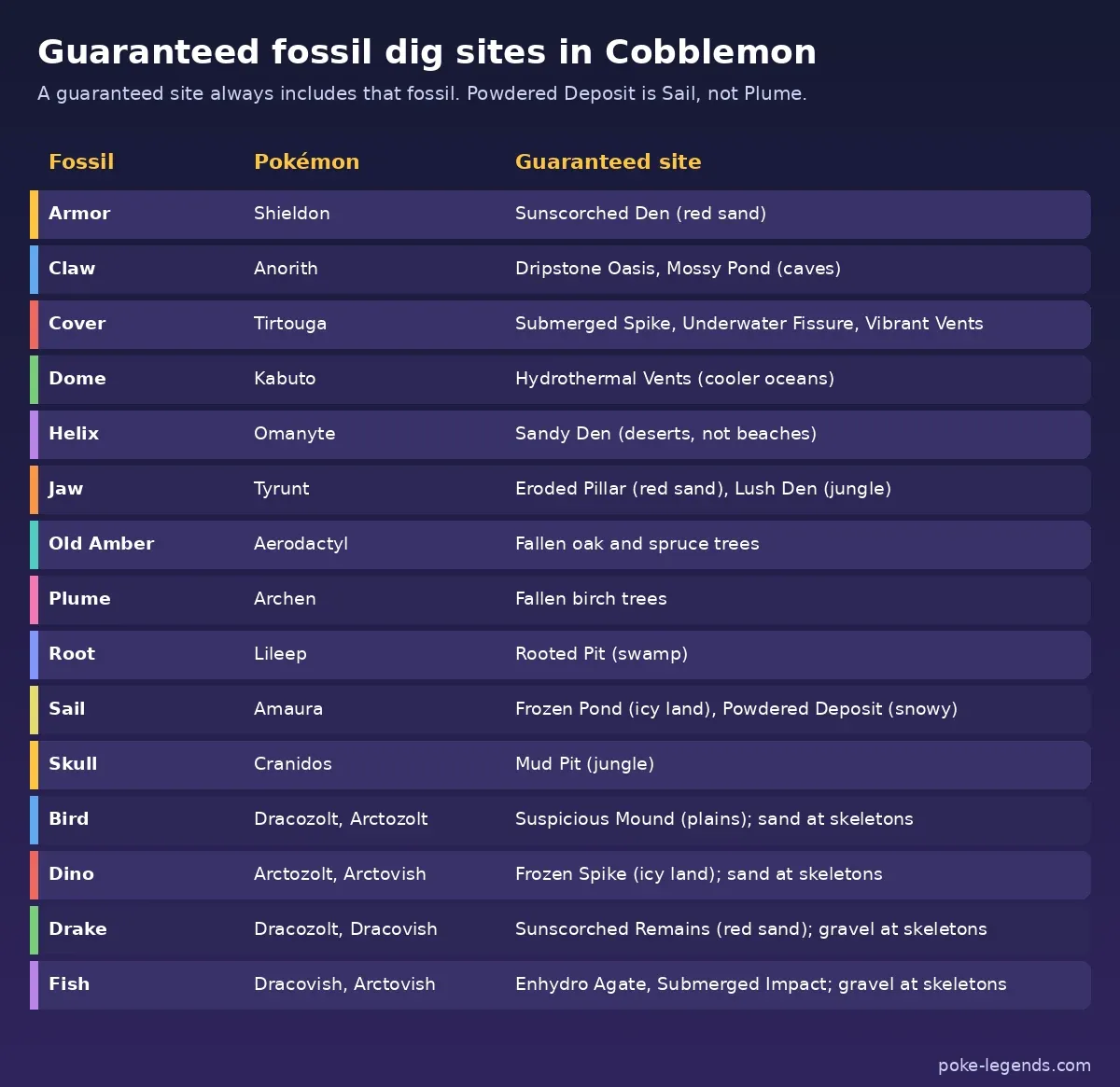
| Fossil | Pokémon | Guaranteed dig site |
|---|---|---|
| Armor Fossil | Shieldon | Sunscorched Den (red sand) |
| Claw Fossil | Anorith | Dripstone Oasis, Mossy Pond (caves) |
| Cover Fossil | Tirtouga | Submerged Spike, Underwater Fissure, Vibrant Hydrothermal Vents |
| Dome Fossil | Kabuto | Hydrothermal Vents (cooler oceans) |
| Helix Fossil | Omanyte | Sandy Den (deserts, not beaches) |
| Jaw Fossil | Tyrunt | Eroded Pillar (red sand), Lush Den (jungle) |
| Old Amber | Aerodactyl | Fallen oak and spruce trees |
| Plume Fossil | Archen | Fallen birch trees |
| Root Fossil | Lileep | Rooted Pit (swamp) |
| Sail Fossil | Amaura | Frozen Pond (icy biomes, not oceans), Powdered Deposit (snowy) |
| Skull Fossil | Cranidos | Mud Pit (jungle) |
| Fossilized Bird | Dracozolt, Arctozolt | Suspicious Mound (plains), sand at preserved skeletons (icy oceans) |
| Fossilized Dino | Arctozolt, Arctovish | Frozen Spike (icy biomes, not oceans), sand at preserved skeletons |
| Fossilized Drake | Dracozolt, Dracovish | Sunscorched Remains (red sand), gravel at preserved skeletons |
| Fossilized Fish | Dracovish, Arctovish | Enhydro Agate (lush caves), Submerged Impact (ocean), gravel at preserved skeletons |
A few of those sites are easy to mix up, so it is worth being precise. Powdered Deposit, in snowy biomes, is a guaranteed Sail Fossil (Amaura), not a Plume Fossil. Plume (Archen) is guaranteed under fallen birch trees. Regular Hydrothermal Vents, in cooler oceans, are a guaranteed Dome Fossil (Kabuto). Cover Fossil (Tirtouga) is guaranteed at Submerged Spike (oceans with ice), Underwater Fissure (deep ocean) and Vibrant Hydrothermal Vents (lukewarm to warm oceans), not at the regular vents. And the preserved skeletons in icy oceans split the Galar pieces by block: sand rolls Fossilized Bird or Fossilized Dino, and gravel rolls Fossilized Drake or Fossilized Fish.
Other sites can drop these fossils too, just not every time. Claw, for example, can also turn up at frozen spikes and several ocean sites, and Old Amber can appear at frozen ponds and lush dens. If you already have the guaranteed piece and you are still brushing, those uncommon rolls are how you pick up a Galar half or a second fossil without changing biomes.
You can also plan the trip by biome instead of by fossil. Red-sand country covers Sunscorched Dens (Armor), Eroded Pillars (Jaw) and Sunscorched Remains (Drake) in one loop. Jungles hold Lush Dens (Jaw) and Mud Pits (Skull), and a swamp next door has the Rooted Pit for Lileep. Icy land biomes, not oceans, are where Frozen Ponds (Sail) and Frozen Spikes (Dino) generate; snowy ground adds Powdered Deposits, another guaranteed Sail. Icy oceans are a different trip: preserved skeletons for the Galar sand and gravel rolls, and Submerged Spikes for Cover. Lush caves and dripstone caves, underground, are where Mossy Ponds and Dripstone Oases (both Claw) sit next to Enhydro Agate (Fish). Fallen oak and spruce trees are your Old Amber, and fallen birch trees are your Plume. Planning a team around what you revive? See how to evolve Pokémon in Cobblemon.
3. Build the Resurrection Machine
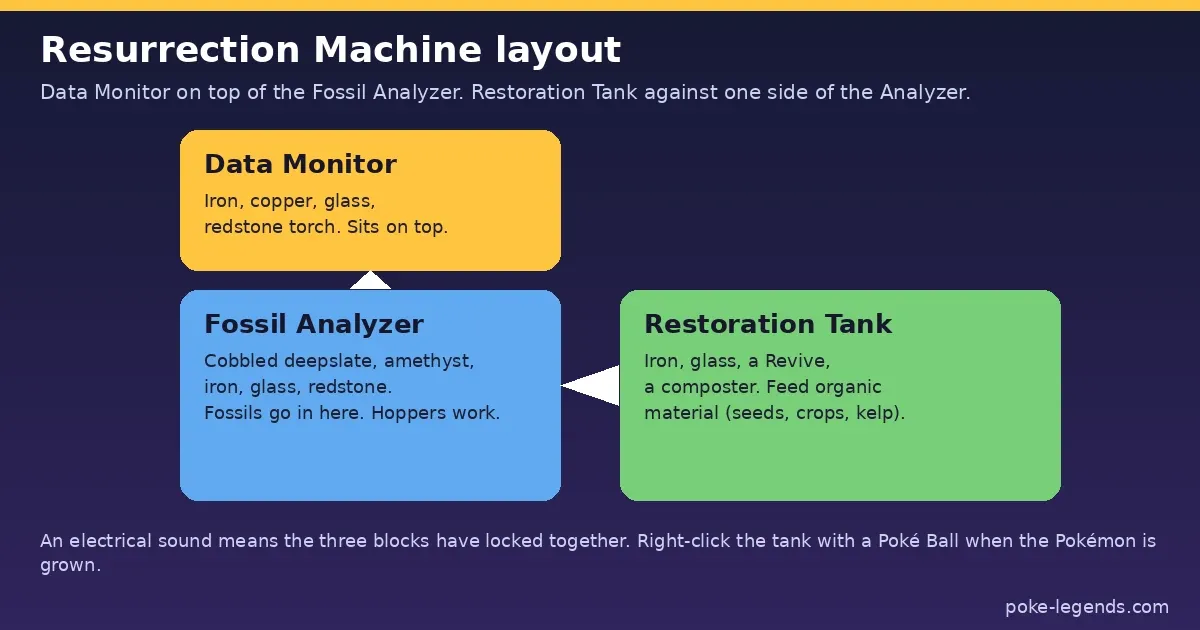
The machine is three blocks placed so they can talk to each other:
- Fossil Analyzer: cobbled deepslate, an amethyst shard, iron ingots, glass and redstone dust, crafted in the pattern deepslate-amethyst-deepslate across the top, iron-glass-iron across the middle, and deepslate-redstone-deepslate across the bottom.
- Restoration Tank: iron ingots, glass, a Revive and a composter, crafted as a row of iron on top, glass-Revive-glass in the middle, and glass-composter-glass on the bottom.
- Data Monitor: iron ingots, copper ingots, glass and a redstone torch, crafted as a row of iron on top, copper-glass-copper in the middle, and iron-redstone torch-iron on the bottom.
Place the Data Monitor on top of the Fossil Analyzer and the Restoration Tank right next to the Analyzer. An electrical sound means the three blocks have locked together as one machine. Hoppers can feed fossils into the Analyzer and organic material into the Tank, so you do not have to stand there dropping items in by hand.
The one ingredient that is not a vanilla crafting staple is the Revive in the tank recipe. On Poke Legends you can make one in a Campfire Pot from Heal Powder and a Honey Bottle, or open /shop, go to Recovery, and buy a Revive if you would rather spend in-game money than hunt the pot ingredients first.
Worked example on mc.poke-legends.com:
- Join with the Cobblemon mod on Java 1.21.1 (match the version our modpack installs). Short steps are in our join guide.
- Craft or buy a Revive, then craft the three machine blocks at your base.
- Place the Monitor on the Analyzer, put the Tank against the Analyzer, and listen for the electrical sound before you start a revive.
4. Revive your fossil
Fill the Restoration Tank with organic material: seeds, crops, berries, leaves, flowers, kelp and more. Put the fossil (or both Galar halves) in the Fossil Analyzer. The tank grows the Pokémon over time. When it is fully grown, right-click the tank with a Poké Ball to add it to your party, or break the tank to release it into the wild. A revived Pokémon can be shiny, so every revive is a chance at one. Collecting shinies more broadly? Our catching guide has more tips.
5. Combine the Galar fossils
The four Galar fossils do not revive on their own. Put both halves in the Analyzer at the same time:
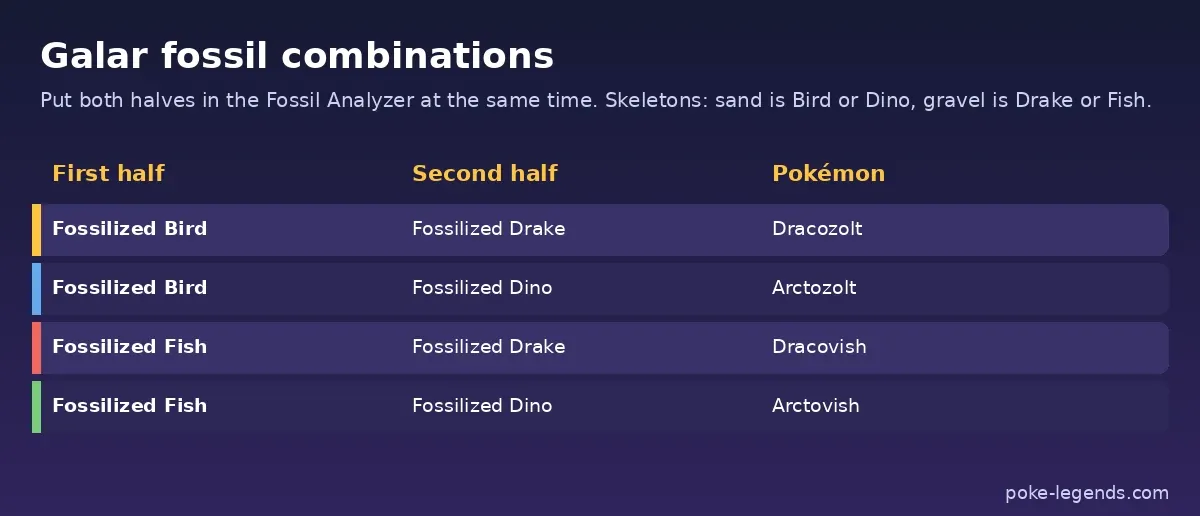
| Combination | Pokémon |
|---|---|
| Fossilized Bird + Fossilized Drake | Dracozolt |
| Fossilized Bird + Fossilized Dino | Arctozolt |
| Fossilized Fish + Fossilized Drake | Dracovish |
| Fossilized Fish + Fossilized Dino | Arctovish |
If you are hunting a specific combo, start at the guaranteed half-sites and use preserved skeletons to roll the other half. Suspicious Mounds on the plains are a reliable Bird. Frozen Spikes in icy, non-ocean biomes are a reliable Dino. Sunscorched Remains in red-sand biomes are a reliable Drake. Enhydro Agate in lush caves and Submerged Impact on the ocean floor are a reliable Fish. A preserved skeleton in an icy ocean then gives you a sand roll (Bird or Dino) and a gravel roll (Drake or Fish), which is often the fastest way to finish a pair once you already have one half. Want to battle with your revives? See our Cobblemon competitive server guide for where to test them.
6. Turn spare fossils into progress
You will dig up more fossils than you need, especially once the uncommon blocks start paying out extras. Sell those duplicates in the Fossils section of /shop (it buys every fossil and does not sell them), and check /goals and /leaderboards to see if fossil restoring is one of the live objectives. It sits in the weekly and monthly leaderboard pools and can appear as a Global Goal, so it is not guaranteed to be the week’s track, but when it is, every revive you already wanted to run counts toward it. For a full video walkthrough of dig sites, watch TrainerMarkyMark’s How to Find Every Fossil in the NEW Cobblemon Update. More ways to earn are in our economy wiki.
Start digging on Poke Legends
On Poke Legends: sell spare fossils in the
/shopFossils section, craft or buy a Revive for your Restoration Tank, and restore fossils for Global Goals and the weekly and monthly leaderboards. All 1025 Pokémon are in the game, so every fossil species and its evolutions are waiting once you revive them. Java Edition 1.21.1; Cobblemon mod required, modpack optional.
- Install Cobblemon for 1.21.1 (or our modpack).
- Join
mc.poke-legends.com. Short steps are on our join page. - 🦴 Join our Discord to show off your revives.
Happy digging, Trainer.
Frequently asked questions
How do you get fossils in Cobblemon?
Craft a brush from a feather, a copper ingot and a stick, then use it on suspicious sand or suspicious gravel at fossil dig sites. Each site always includes a rare block for a specific fossil, and other suspicious blocks at the same site can drop mixed fossils too.
How do you revive a fossil in Cobblemon?
Build a Resurrection Machine: a Fossil Analyzer with a Data Monitor on top and a Restoration Tank next to it. Fill the tank with organic material like seeds, crops or kelp, put the fossil in the Analyzer, and wait until the Pokémon is fully grown. Then right-click the tank with a Poké Ball, or break the tank to release it into the wild.
How many fossils are in Cobblemon?
There are 15 fossils in Cobblemon. Eleven revive on their own, and the four Galar fossils (Bird, Drake, Dino and Fish) are combined in pairs to make Dracozolt, Arctozolt, Dracovish or Arctovish.
What are the Galar fossil combinations in Cobblemon?
Fossilized Bird plus Fossilized Drake makes Dracozolt. Bird plus Dino makes Arctozolt. Fish plus Drake makes Dracovish. Fish plus Dino makes Arctovish.
Can revived fossil Pokémon be shiny?
Yes. A revived Pokémon can be shiny, so every revive is a chance at one.
What can I do with spare fossils on Poke Legends?
Sell them in the Fossils section of /shop for in-game money. The shop buys all 15 fossils and does not sell them back, so the ones you want to revive still have to be dug up. Restoring fossils can also count toward server-wide Global Goals (/goals) and the weekly and monthly leaderboards (/leaderboards).